Last Updated: October 28, 2026
Quick Summary
Managing after-hours office cleaning schedules starts with a written scope built from a building walkthrough, then grouping tasks into daily, weekly and monthly frequencies. Build a reusable template with per-zone cleaning windows, sequenced task routes, access records and a sign-off step so crews verify completion before they leave.
- Walk the building with your office manager and note what gets cleaned, how often, and what done looks like.
- Group tasks into daily, weekly and monthly buckets instead of putting everything on the daily list.
- Sequence the route from restrooms and trash to open floors, then noisy low-traffic work, then close-out.
- Give each zone its own cleaning window rather than one building-wide start time.
- Name one on-call employee per zone and cross-train at least two people on each building.
Table of Contents
- Start With a Walkthrough and a Written Scope
- Build Your Office Cleaning Task Frequency Into the Plan
- Use a Daily, Weekly and Monthly Office Cleaning Checklist
- Set Up Building Access, Security and Key Control
- Map Shift Handoffs and Communication Between Crews
- Write an Office Cleaning Schedule Template You Can Reuse
- Choose Cleaning Staff Scheduling Software That Fits Your Building
- Plan Backup Coverage for Absences and Schedule Changes
- Frequently Asked Questions
Start With a Walkthrough and a Written Scope
Managing after-hours office cleaning schedules starts with a slow walk through the building after everyone has gone home. A written scope can help clarify the cleaning tasks and their frequency. It lists every room, every surface, and how often each one needs attention.
Walk the space with your office manager or admin team and note three things per area:
- What gets cleaned
- How often
- What "done" looks like
This becomes the base document for every schedule you build. For a deeper look at aligning cleaning with your office hours, see how to plan cleaning around office operating hours.
Build Your Office Cleaning Task Frequency Into the Plan
Not every task belongs on the same clock. Office cleaning task frequency is the backbone of a workable schedule, because it decides how many staff hours you actually need. Group tasks into three buckets:
- Daily: trash removal, restroom sanitation, high-traffic floors
- Weekly: desks and shared surfaces, break room deep wipe-down
- Monthly: vents, baseboards, interior glass, carpet spot care
A common mistake is putting everything on the daily list. That bloats the schedule and pushes crews to rush. Match frequency to real use, and the plan gets leaner and more honest.
Use a Daily, Weekly and Monthly Office Cleaning Checklist
A daily, weekly and monthly office cleaning checklist can turn the scope into a task list. Keep it short, and keep it specific.
| Frequency | Core Tasks | Areas |
|---|---|---|
| Daily | Trash removal, restroom sanitation, spot mopping | Restrooms, break rooms, walkways |
| Weekly | Desk and counter wipe-down, glass touch points | Desks, counters, shared surfaces |
| Monthly | Vents, baseboards, deep carpet care | High-traffic areas, corners |
Then check the work against the list. A quality control inspection routine, like the one covered in our guide to janitorial quality control inspections, keeps the checklist honest.
Set Up Building Access, Security and Key Control
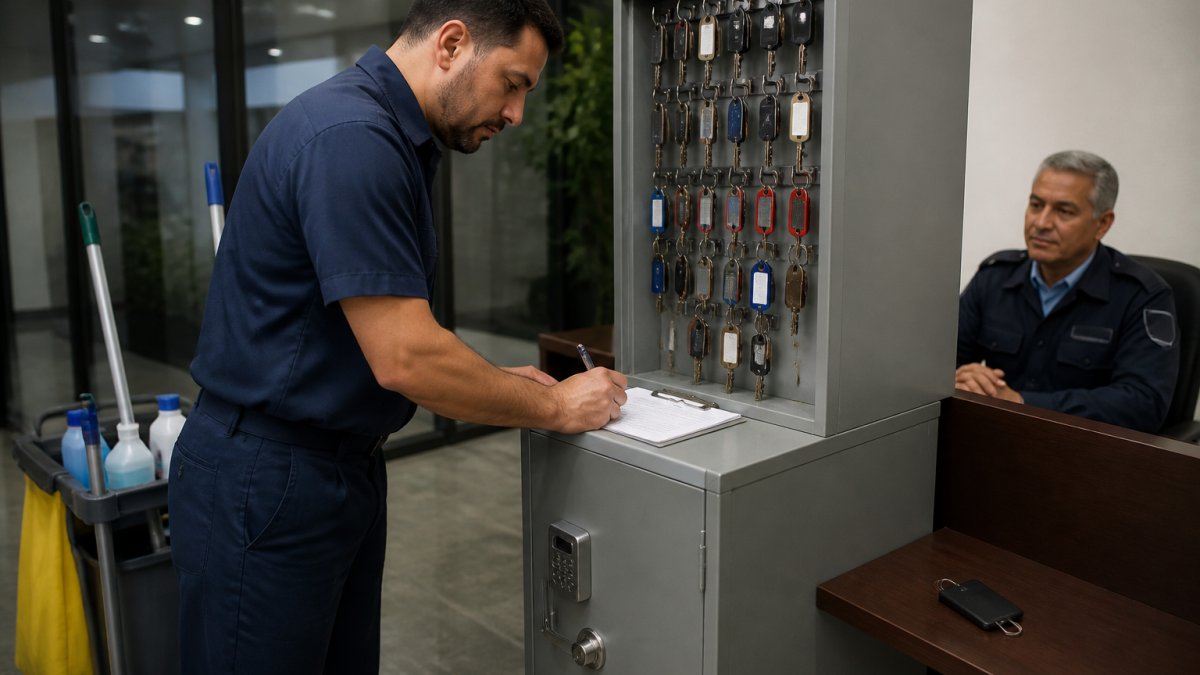
After-hours office cleaning means trusting a crew with keys, codes, and alarm systems. That is the part most schedules skip, and it is where problems start.
Build a simple access record:
- Who holds a key or fob
- Which doors they open
- When access was granted
- When it was returned
Use one alarm code per crew, change it when staff turn over, and log every entry. Bonded, background-checked staff. If you want to understand what bonding actually covers, read the benefits of hiring bonded cleaning staff.
Map Shift Handoffs and Communication Between Crews
A schedule breaks at the handoff, not in the middle of a shift. When one crew leaves and another arrives, details get lost: a spill, a broken fixture, a supply running low.
Fix it with a short written handoff. A shared log or app note with three lines works:
- What was finished
- What was missed
- What needs attention next
An area supervisor should review the log each morning.
Write an Office Cleaning Schedule Template You Can Reuse
An office cleaning schedule template saves hours every month, but most templates are just blank grids. For after-hours work, the template has to carry the operational logic: when the building is empty, what order tasks run in, and how completion gets confirmed before the crew locks up. Build it once, then adjust for holidays and staff changes.
Include these fields on your template:
- Date and shift time slot (for example, 6:00 p.m. to 10:00 p.m.)
- Assigned cleaner or team, plus the on-call backup for that zone
- Zone or floor, with the access method noted (key, fob, alarm code)
- Task list by frequency, sequenced in the order the crew should work
- Estimated minutes per task and per zone
- Sign-off line with time completed
- Notes for the next crew and any hazards flagged
Sequence Tasks in the Order the Building Empties
After-hours scheduling is not just a list of tasks, it is a route. A practical pattern most supervisors settle into is:
- First pass (highest-traffic, highest-risk): restrooms, break rooms, and trash removal, because these are the areas day staff notice first in the morning.
- Second pass (open floor): desks, counters, shared surfaces, and spot mopping of walkways once people have cleared out.
- Third pass (low-traffic and noisy work): vacuuming, interior glass, baseboards, and any equipment that runs loud, so noise does not carry into occupied space or neighboring suites.
- Close-out: reset furniture, confirm restroom supplies, check that no wet-floor signs are left out, and complete the sign-off.
Sequencing this way means the crew is not doubling back across floors, and the most visible work is finished even if the shift runs short.
Set Cleaning Windows Around Occupancy, Not the Clock
A cleaning window is the block of time a zone is actually available. Map it against real occupancy rather than assuming the whole building is empty at 6:00 p.m. Some tenants work late, some suites lock earlier, and some floors are vacant entirely. Note per zone:
- Earliest safe start time
- Latest finish time before alarm re-arm or building lock-down
- Any blackout periods (events, board meetings, overtime shifts)
Verify Completion Before the Crew Leaves
The template is only as good as its sign-off. Require the crew lead to walk the route at the end of the shift and mark each zone complete, partial, or missed, with a one-line reason. That record feeds the morning review and gives the area supervisor something concrete to inspect against. A template without a verification step is a wish list.
Keep one master copy and one working copy per week. The master stays clean, so you never rebuild the format from scratch.
Choose Cleaning Staff Scheduling Software That Fits Your Building
Cleaning staff scheduling software helps most once you have more than one crew or more than one floor. Before that, a shared spreadsheet does the job. The decision is less about features than about whether the tool suits your scheduling needs.
Look for these features:
- Mobile-friendly scheduling for staff on the move
- Task rotation and route planning by zone and floor
- Shift coverage alerts when a crew member calls out
- Photo check-ins and time-stamped sign-offs for task completion
- Access notes attached to each zone (key, fob, alarm code) so the right person is dispatched
- A handoff log the morning supervisor can read without calling anyone
Skip tools that bury the basics under add-ons you will never use. If you are weighing in-house staff against an outside team, our janitorial and office cleaning service shows what a managed schedule looks like in practice.
Measure Whether the Schedule Is Actually Working
Software earns its cost when it produces evidence. Define a small set of measures before you buy, and make sure the tool can report them:
- Task completion rate: zones signed off complete versus zones scheduled
- Inspection scores: results from your quality control walkthroughs, tracked over time
- Response time: how quickly a missed task or complaint is closed after it is logged
- Complaint volume: count by area and by week, so patterns show up
- Labor hours versus scheduled hours: where the estimate and the reality diverge
Review the measures monthly and adjust frequencies rather than adding staff by default.
Weigh the Trade-offs Before You Commit
Software adds a layer between the supervisor and the crew. That layer pays off when:
- More than one floor or building is in scope
- Crews rotate and handoffs happen daily
- You need a defensible record for a client or property manager
Revisit the decision when you add a second building or a second shift.
Plan Backup Coverage for Absences and Schedule Changes
Every schedule may need to account for absences.
Name one on-call employee per zone. Cross-train at least two people on each building so anyone can step in. Build a short list of tasks that can wait a day and tasks that cannot, like restroom sanitation and trash removal.
Then test the plan. Call out a crew member on paper and see who covers what. A plan that only works when everyone shows up is not a plan.
Frequently Asked Questions
How do you create an after-hours office cleaning schedule?
Start with a walkthrough to record rooms and high-traffic areas, then write a scope that names the tasks and how often each one happens. Group tasks into lists and consider access instructions and a handoff note process.
What office cleaning tasks should be done daily, weekly, and monthly?
Cleaning tasks and their frequency depend on the facility's needs. A scope can list the tasks and how often each area needs attention.
How do you manage building access for after-hours cleaners?
Ask your provider whether staff are background-checked, bonded and insured.
How can you check the quality of after-hours office cleaning?
Ask the provider what inspection process it uses and how it handles concerns.
Scheduling after-hours cleaning around a busy office is hard, and one missed shift shows up fast. Master Cleaning handles it with a same trained team assigned to each visit, flexible scheduling that fits your operating hours, and consistent standards checked through regular inspections. We are bonded and insured, and we back the work with a 100% satisfaction guarantee. Contact us to set up a schedule that holds up on the busy weeks, not just the easy ones.
