Last Updated: October 26, 2026
Quick Summary
Janitorial quality control inspections are worth it because they turn cleaning promises into verified, measurable outcomes you can track, score, and fix. They provide proof that contracted tasks were completed, catch health and safety hazards early, and create a documented paper trail for compliance. Inspections also give you data to adjust scope and frequency so your cleaning standards match how the building is actually used.
- Define what clean means for each area, then inspect against that written standard.
- Score each area on a 1-4 rubric and track the overall score trend over time.
- Weight high-visibility and high-risk areas like entrances and washrooms at double.
- Assign each deficiency to a named person with a deadline, then re-inspect to confirm.
- Any item failing twice in a row moves to a root-cause review with the supervisor.
Table of Contents
- What a Janitorial Quality Control Inspection Actually Delivers
- How Cleaning Quality Shapes First Impressions and Professional Image
- Health, Safety, and Compliance Wins From Regular Inspections
- How to Assess Janitorial Quality Without Guesswork
- Building a Janitorial Inspection Checklist That Works
- Cleaning Inspection Frequency: How Often Is Enough?
- Using a Cleaning Inspection Checklist Template and Scoring Rubric
- Turning Findings Into Corrective Action and Better Morale
- Frequently Asked Questions
What a Janitorial Quality Control Inspection Actually Delivers
A janitorial quality control inspection is a scheduled, documented check of cleaning work against agreed standards.
That shift matters more than most facility managers expect. Without inspections, you're paying for a promise.
Here's the honest version of what those inspections deliver, and how to run them yourself if you're managing a cleaning crew.
What an inspection actually gives you:
- Proof that contracted tasks were completed
- An early warning system for maintenance issues
- A paper trail for health and safety compliance
The last point is the one most guides skip. Inspections aren't just a report card.
How Cleaning Quality Shapes First Impressions and Professional Image
Walk into a reception area with smudged glass and dull floors and your visitors form an opinion before anyone speaks.
Retail stores feel this most sharply. A sticky floor or dusty shelving tells customers something about how you run the business.
First impressions depend on a few high-visibility zones:
- Entrance doors, glass, and reception surfaces
- Washrooms, which visitors judge harshly and remember
- Floors in traffic paths
A good inspection program weights these areas heavily. You can also see the janitorial and office cleaning service these inspections are designed to check.
Health, Safety, and Compliance Wins From Regular Inspections
Cleaning is a health and safety function, not just a cosmetic one.
Workplace hygiene affects occupant health directly. Dust, poor ventilation, and contaminated high-touch surfaces all feed into absenteeism and complaints.
Compliance is the other half. Many facilities operate under health and safety obligations that require documented diligence.
What inspections catch that walkthroughs miss:
- Slip and trip hazards left unaddressed
- Sanitation gaps in washrooms and food prep areas
- Damaged fixtures that create injury risk
Different facilities carry different rules. Our breakdown of how cleaning standards differ by facility type covers what each environment needs.
How to Assess Janitorial Quality Without Guesswork
Most quality complaints come down to a missing standard. If nobody defined what "clean" means for a given surface, every review becomes an argument.
The fix is simple: define the standard, then inspect against it. Here's how to assess janitorial quality without relying on gut feel.
- Write the standard down. Specify what each area should look like after service.
- Inspect at a consistent time. Check after cleaning, not mid-shift.
- Score, don't just note. Use a simple scale so results are comparable week to week.
- Check randomly as well as scheduled. Spot checks keep performance honest.
- Record everything. Photos and notes turn opinions into evidence.
A common mistake is inspecting only when something goes wrong. That turns inspections into punishment and destroys trust with the cleaning crew.
If you'd rather hand the assessment to a professional team, you can request a commercial cleaning quote and have your facility reviewed against a defined standard.
Building a Janitorial Inspection Checklist That Works
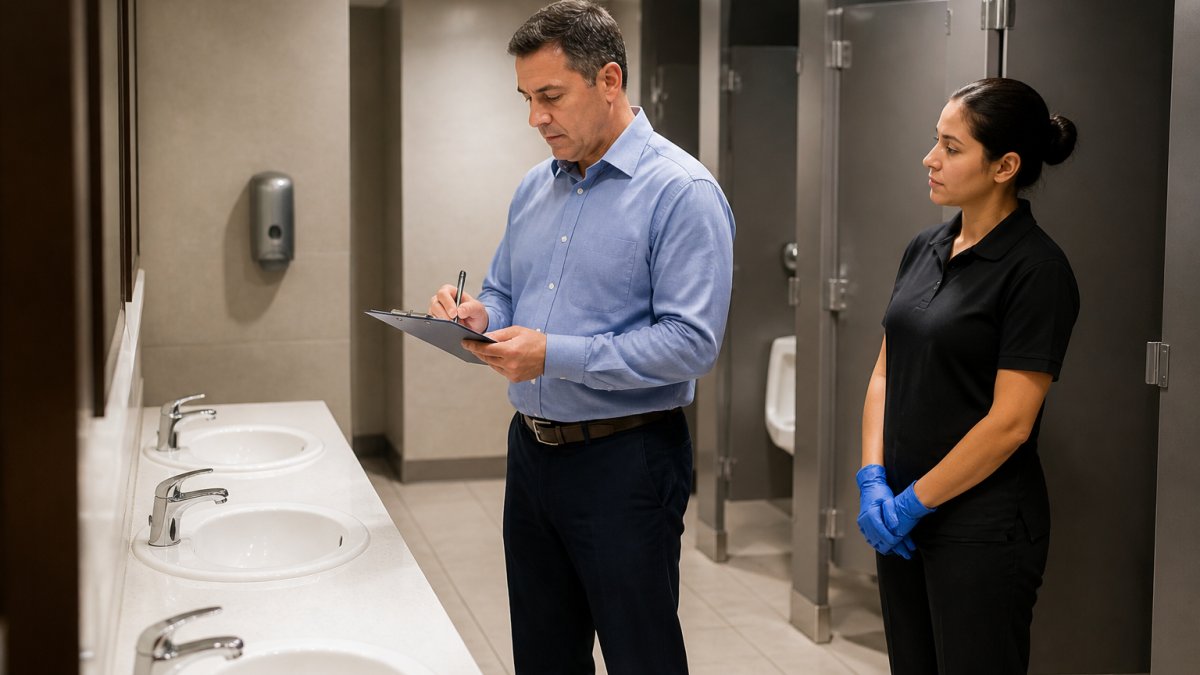
A janitorial inspection checklist is a room-by-room list of what "clean" looks like, scored consistently each visit. Build it once, refine it quarterly, and it will do more for cleaning consistency than any verbal instruction.
Start with these categories:
- Washrooms: fixtures, mirrors, dispensers, floors, odor
- Floors: traffic paths, corners, edges, under furniture
- Surfaces: desks, ledges, glass, high-touch points
Then add a trust layer. Our article on the benefits of hiring bonded cleaning staff explains what background checks should cover, which belongs in your checklist as a verification item.
A Room-by-Room Checklist You Can Copy
Use pass/fail for each line. Add a photo requirement for any fail. The items below are the ones most often missed on a first inspection.
Entrances and reception
- Glass doors and sidelights free of streaks, fingerprints, and smudges
- Door handles and push plates wiped and disinfected
- Mats vacuumed, straight, and free of debris underneath
Washrooms
- Fixtures, taps, and handles descaled and disinfected
- Mirrors streak-free at eye level and edges
- Dispensers filled, working, and aligned
Workstations and shared surfaces
- Desks, monitors stands, and phone handsets wiped (where in scope)
- High-touch points, light switches, door handles, shared keyboards, disinfected
- Ledges, partitions, and glass dividers dust-free
Break rooms and kitchens
- Counters and backsplash free of residue and crumbs
- Sink drained, taps descaled, no standing water
- Appliance exteriors, microwave, fridge handles, coffee station, wiped
Floors and traffic paths
- Traffic paths free of scuffs, gum, and residue
- Corners, edges, and under furniture reached
- No wet floors without signage
Waste and storage
- Bins emptied, liners replaced, exteriors wiped
- Storage areas secure and tidy
- Chemicals labeled and stored per safety requirements
Weight the Checklist by Visibility and Risk
Not every line deserves equal weight. A common pattern is to score high-visibility and high-risk areas, entrances, washrooms, food areas, at double the weight of back-of-house storage. That prevents a perfect storage closet from masking a streaked front door. Set the weighting once, document it, and apply it every inspection so scores stay comparable.
Keep the Checklist Alive
Review the checklist quarterly against complaint logs and inspection findings. If the same line fails repeatedly, either the standard is unrealistic or the task is not resourced, both are worth knowing. Add new lines only when a real deficiency shows the current list missed something. A checklist that grows without pruning becomes noise, and inspectors start skipping items.
Cleaning Inspection Frequency: How Often Is Enough?
Cleaning inspection frequency should match your facility's risk and traffic. A single weekly inspection suits a low-traffic office. A medical practice or restaurant needs more frequent checks.
A practical starting point:
| Facility Type | Routine Inspection | Spot Check |
|---|---|---|
| Low-traffic office | Weekly | Monthly |
| Busy corporate office | Twice weekly | Weekly |
| Retail | Twice weekly | Weekly |
| Medical or dental | Daily or per shift | Weekly |
| Restaurant or food service | Daily | Weekly |
| School or community center | Weekly | Biweekly |
Treat this as a starting baseline, then adjust. If complaints rise or scores dip, increase frequency. If scores stay strong for a quarter, you can ease off. The goal is inspection frequency that catches problems early without turning into busywork.
Using a Cleaning Inspection Checklist Template and Scoring Rubric
A cleaning inspection checklist template saves you from rebuilding the process each time.
A simple rubric that works:
- 4 - Excellent: meets standard fully, nothing to correct
- 3 - Good: minor issues, no follow-up needed
- 2 - Needs work: visible deficiencies, correction required
Score each area, then average for an overall inspection score. Track that number over time.
Template structure to copy:
Facility: ___________ Date: ___________ Inspector: ___________ Area / Score (1-4) / Notes / Photo attached (Y/N)
Washrooms: ___ ______________________ ___ Floors: ___ ______________________ ___ Surfaces: ___ ______________________ ___ Waste: ___ ______________________ ___ Break rooms: ___ ______________________ ___ Entrances: ___ ______________________ ___
Overall score: ____ / 24 Corrective actions assigned: _______________ Re-inspection date: _______________ Digital inspection tools help here.
Turning Findings Into Corrective Action and Better Morale
An inspection that ends with a score and no follow-up is wasted effort. Corrective action is where quality actually improves. Most guides stop at "give feedback", the gap is the closed loop that assigns, deadlines, verifies, and escalates.
A workable corrective action loop:
- Log each deficiency with a photo and location
- Assign it to a named person with a deadline
- Fix it and record the fix
- Re-inspect to confirm
- Review patterns monthly, not just individual misses
Assign, Deadline, Verify
A finding without an owner and a date is a wish. Use a simple severity scale to set the deadline:
- Critical (safety or health): correct immediately or before the next shift; re-inspect same day
- Major (visible to occupants or clients): correct within 24 hours; re-inspect next visit
- Minor (cosmetic or back-of-house): correct by the next scheduled service; verify at next routine inspection
Assign each finding to a named person, not a team, and record the deadline in the same log as the photo. When the fix is recorded, the inspector re-inspects that specific item and marks it closed. Do not close an item on a verbal confirmation; close it on a verified re-check.
Escalate Recurring Failures
A single miss is a training moment. The same miss three inspections running is a system problem, understaffing, unclear scope, wrong product, or a task that was never resourced. Set a rule: any item that fails twice in a row moves to a root-cause review with the cleaning supervisor, and any item that fails three times triggers a scope or staffing review.
Make It Fair and Safety-Conscious
Staff feedback is the part that separates good programs from resented ones. Give janitorial staff the checklist before the inspection, not after. Show them the scores. Praise the areas that score well. Use objective criteria, the same checklist, the same weighting, the same pass/fail rules, so the result is defensible. Coach on the finding, not the person. And inspect safely: do not ask staff to reach, climb, or handle chemicals during an inspection, and respect privacy in washrooms and change areas by inspecting after hours or with notice.
Track the Numbers That Matter
Quality metrics worth tracking:
- Overall inspection score trend
- Complaint count and complaint reduction over time
- Re-inspection rate (how often a fix fails verification)
These four or five numbers tell you more about service quality than any single walkthrough. They also support cost savings conversations, because you can show what is working and what to change. Review them monthly alongside the corrective-action log, and use the trend, not one bad week, to decide whether to adjust scope, frequency, or staffing.
For more guidance on running commercial cleaning programs, our blog covers related topics in depth.
Frequently Asked Questions
What is the main purpose of a janitorial quality control inspection?
A janitorial quality control inspection exists to verify that cleaning work meets agreed standards before problems reach occupants or customers. It checks surfaces, high-touch areas, washrooms, floors, and waste handling against a written checklist, assigns a score, and flags deficiencies for correction. The purpose is not to catch staff out but to create a repeatable record of cleaning performance, so facility managers can spot trends, request re-inspection when needed, and hold the cleaning crew accountable to the same standard every visit.
How often should janitorial services be inspected?
Cleaning inspection frequency depends on traffic and risk. High-traffic or clinical spaces may need weekly or even daily spot checks, while standard offices often work well with a weekly walkthrough plus a monthly full audit. Retail and institutional facilities commonly land in between. Build in a re-inspection after any deficiency is corrected, and adjust frequency if complaint volume rises. A consistent schedule matters more than a strict one, because irregular inspections let cleaning consistency slip without anyone noticing until a customer complains.
What should a janitorial inspection checklist include?
A practical janitorial inspection checklist covers room-by-room tasks: washroom fixtures, soap and paper supplies, mirrors, floors, waste bins, high-touch points like door handles and light switches, kitchen and breakroom surfaces, glass, and entryways. Include a scoring column so each item gets a pass, fail, or numeric rating, plus space for notes and photos. Add a section for health and safety items such as hazard identification and blocked exits. A cleaning inspection checklist template with these fields keeps audit results comparable from one inspection to the next.
How do cleaning inspections improve accountability and staff morale?
Inspections make expectations visible. When janitorial staff know the same checklist is used every time, feedback becomes specific rather than personal, and corrective action is easier to accept. Documented scores let you recognize good work publicly, which lifts team morale, and address repeat issues with targeted retraining instead of blanket criticism. The result is fewer customer complaints, clearer communication between facility managers and the cleaning crew, and a measurable record of improvement that supports both tenant satisfaction and employee wellbeing.
Managing cleaning quality without a system means guessing, and guessing gets expensive. Master Cleaning builds regular inspections into every plan, with bonded and insured staff, background-checked employees, and the same trained team assigned to each visit. Our customized cleaning plans set clear standards for your facility, and our 100% satisfaction guarantee backs the work. Get started with Master Cleaning and turn cleaning quality into something you can measure, not hope for.
