
Table of Contents
- Start With Your Operating Hours and Occupancy Pattern
- Map High-Priority and High-Traffic Areas Before You Schedule
- Build Your Office Cleaning Checklist by Frequency
- Split Tasks Between Daytime Office Cleaning and After-Hours Office Cleaning
- Use an Office Cleaning Schedule Template That Adapts to Shift Work
- Control Noise, Privacy, and Access During Cleaning
- Measure Service Levels and Adjust the Schedule
- Request a Cleaning Plan Built Around Your Hours
- Frequently Asked Questions
Last Updated: October 25, 2026
Start With Your Operating Hours and Occupancy Pattern
Cleaning that fits your business starts with one question: when is the office actually empty?
A law office that empties by 6 PM is a different job from a clinic with evening appointments. Both need a schedule that matches how the space is used.
Start by writing down three things:
- Opening and closing times for each day of the week
- Peak hours when desks, boardrooms, and washrooms are busiest
- Quiet windows when most staff are out or working remotely
Then note who stays late.
The Canadian Centre for Occupational Health and Safety treats workplace cleanliness as part of a healthy indoor environment, which makes this planning step a safety matter, not just a tidiness one.
Get this wrong and you either pay for cleaning you don't need or skip areas that get hammered daily.
Map High-Priority and High-Traffic Areas Before You Schedule
Not every square metre earns the same attention. High-traffic areas need daily care; a storage room can wait a week.
Walk the office and flag:
- Entrances and reception where outdoor grit lands
- Washrooms and kitchens where hygiene matters most
- Shared spaces like boardrooms and break rooms
Rank each zone high, medium, or low priority. A medical or dental office pushes washrooms and exam rooms to the top.
Here's what most guides miss: the priority list should change with the season. Winter slush turns an entrance from medium to high in a hurry.
Build Your Office Cleaning Checklist by Frequency
A cleaning checklist works best when it's split by how often each task happens. Daily, weekly, and monthly tasks belong on separate lists so nobody wastes a visit on a monthly job.
The full scope of commercial cleaning services, scoped to your facility usually covers janitorial, carpet, floor, window, and specialty cleaning, which maps neatly onto these three tiers.
Daily Tasks
These are the non-negotiables that keep a workplace hygienic and presentable:
- Empty waste and recycling bins
- Wipe and disinfect washrooms and touchpoints
- Clean kitchen and break room surfaces
Weekly and Monthly Deep Cleaning
Weekly tasks handle buildup daily work can't. Monthly tasks catch what weekly work misses.
- Weekly: vacuum under furniture, dust ledges and vents, mop all hard floors, clean glass doors
- Monthly: deep-clean carpets, wash interior windows, clean baseboards, sanitize high shelves
The ISSA cleaning industry standards frame this tiered approach as routine maintenance, and it's the backbone of any workable office cleaning checklist.
Split Tasks Between Daytime Office Cleaning and After-Hours Office Cleaning
Splitting tasks by time of day is where a schedule earns its keep. Daytime office cleaning handles light, low-disruption work while people are present. After-hours office cleaning takes on the noisy, thorough jobs once the space clears.
Daytime tasks suit a quick pass:
- Wipe high-touch surfaces and door handles
- Empty the busiest bins
- Spot-clean washrooms and restock supplies
Daytime work keeps the office presentable through the day without getting in anyone's way.
What Belongs in After-Hours Office Cleaning
Save the disruptive jobs for after hours:
- Vacuuming and carpet care
- Mopping and floor buffing
- Deep disinfection of washrooms and kitchens
Our janitorial and office cleaning teams work to this split every day, scheduling quiet upkeep during business hours and the heavy work after the doors close. That's how you avoid the classic mistake of running a loud vacuum through a client meeting.
Use an Office Cleaning Schedule Template That Adapts to Shift Work
A fixed schedule breaks the moment your office runs shifts or hybrid weeks. The fix is a template built on occupancy, not the clock alone, and the rules below are what separate a schedule that survives a real month from one that collapses the first time a team goes remote.
Build the template in four layers
- Area list (down the side). Every zone from your priority map: reception, washrooms, kitchen, boardrooms, open workstations, private offices, storage, and any secure rooms.
- Day columns (across the top). Monday through Sunday, with a separate column for statutory holidays and office closures.
- Occupancy band per cell. Mark each area as empty, low, normal, or peak for that day. This is the column most templates leave out, and it is the one that drives every decision.
- Task and window. In each cell, note the task and whether it runs before opening, during a low-traffic window, at closing, or after hours.
Scheduling rules for variable occupancy
- Staggered shifts: clean washrooms and break rooms before each shift change, not after. If a shift starts at 6 AM, the washrooms need to be done by 5:45 AM; if a second shift starts at 2 PM, schedule a midday pass between 1:30 and 2:00 PM.
- Hybrid attendance: anchor deep cleans to the days a floor is least occupied. If most staff are remote on Fridays, move that floor's vacuuming and carpet care to Friday and keep only touchpoint wiping on peak days.
- Extended operating hours: split the day into bands (for example, before 8 AM, 8 AM-noon, noon-4 PM, after 4 PM) and assign each band a task type. Quiet upkeep fits the busy bands; noisy work fits the edges.
A sample weekly grid
| Area | Mon | Tue | Wed | Thu | Fri | Window |
|---|---|---|---|---|---|---|
| Reception and entrance | High | High | High | High | High | Before opening |
| Washrooms | High | High | High | High | High | Twice daily |
| Kitchen and break room | High | High | High | High | Medium | Midday and closing |
| Boardrooms | Medium | Medium | Medium | Medium | Low | After last meeting |
| Open workstations | Medium | Medium | Medium | Medium | Low | After hours |
| Private offices | Low | Low | Low | Low | Low | Weekly, by request |
| Storage and archive | Low | Low | Low | Low | Low | Monthly |
Keep the template honest
Review the grid against actual attendance once a month. If a floor that was marked low on Fridays is consistently full, the schedule is wrong, not the staff. Adjust the occupancy band first, then the task frequency, never the other way around.
The template should flex with your week, not force your week to flex around it.
Control Noise, Privacy, and Access During Cleaning
Disruption is the top complaint about daytime cleaning, and it is entirely avoidable. Noise, privacy, and access controls keep staff comfortable while the work gets done, but they only work when they are written into the schedule as rules, not left to the cleaner's judgment.
Noise controls
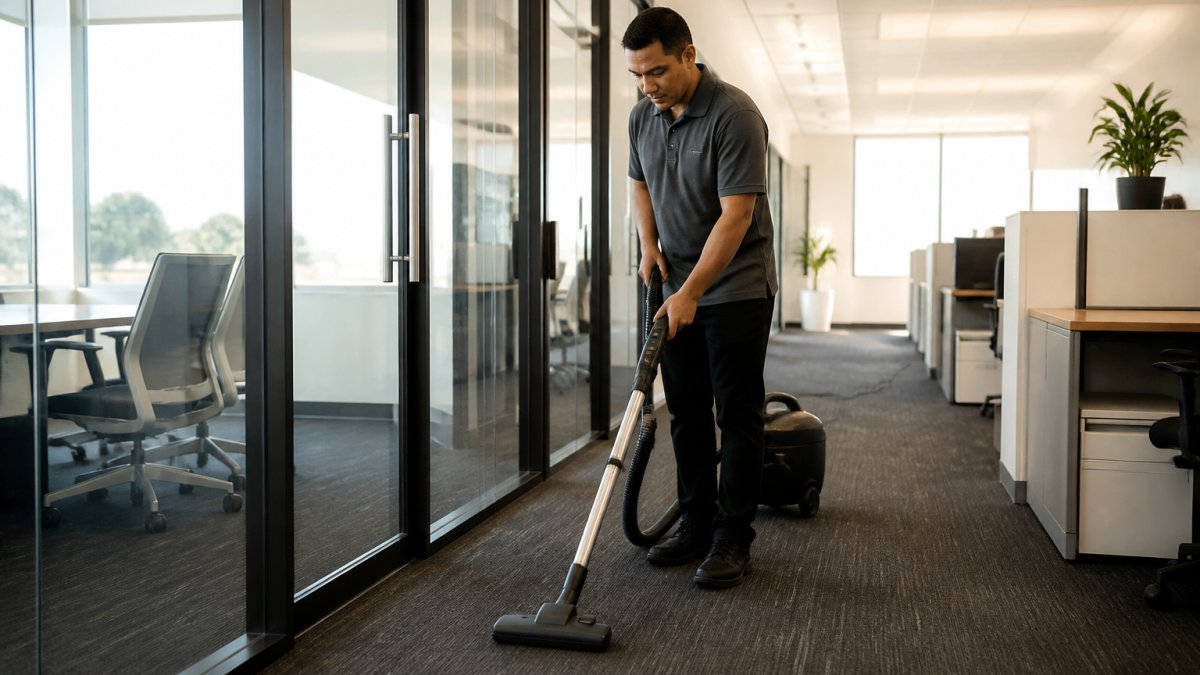
- Match equipment to the time band. Vacuums, floor buffers, and carpet extractors belong after hours or in confirmed empty zones. During occupied hours, use quiet-mode vacuums, microfibre flat mops, and manual sweepers.
- Schedule around meetings, not through them. Ask for the boardroom calendar each week and block cleaning windows around booked meetings. A 15-minute buffer before and after each meeting prevents the classic walk-in.
- Zone the noise. If a floor is half empty, clean the empty half during the day and leave the occupied half for after hours. Mark the boundary on the template so the cleaner knows where to stop.
Privacy controls
- Clean around occupied desks, never through them. Do not move papers, open drawers, or touch screens. If a desk is occupied, skip it and note it for the next visit.
- Confidential areas need a protocol. For legal, medical, HR, and finance rooms, agree in advance whether cleaning happens with a staff escort, after hours only, or not at all. Document the rule in the schedule.
- Use closed-door signals. A closed door or a 'do not disturb' sign means skip the room and return later. Brief the team on the signal before the first visit.
Access coordination
- Keys, fobs, and alarm codes: assign one named contact per site, confirm codes in writing before the first clean, and set a rule for code changes. Uncoordinated access is the most common cause of a missed cleaning visit.
- Alarm handling: agree who arms and disarms the alarm, what happens if the cleaner arrives and the alarm is still set, and who to call after hours. Put the number on the schedule.
- Secure areas: list every locked room, who holds the key, and whether cleaning is inside or outside the scope. Do not assume a cleaner has access to a server room or records room.
Safety and chemical controls
- Wet-floor controls: use cones and signs, and mop one section at a time so a dry path always exists.
- Chemical handling: keep Safety Data Sheets on site, store chemicals in a locked cupboard, and never decant into unlabeled bottles. Staff should know the location of the nearest eyewash station.
- Slips and cords: route vacuum cords along walls, not across walkways, and coil them when not in use.
Who's in the building matters too. Our teams are bonded and background-checked, and you can read about the benefits of hiring bonded cleaning staff before you hand over access.
Measure Service Levels and Adjust the Schedule
A schedule isn't finished when it's written. It needs a feedback loop. Set clear service levels, then check them against what actually happens.
Track three things:
- Completion: did every task on the checklist get done?
- Quality: do washrooms, kitchens, and entrances meet the standard?
- Disruption: did cleaning interfere with staff or clients?
Do a short walk-through each week and adjust. For more practical approaches to refining your plan, browse our blog on commercial and janitorial cleaning.
The Public Services and Procurement Canada guidance on facility management reflects the same principle: measure, then adjust.
Request a Cleaning Plan Built Around Your Hours
The best cleaning schedule is the one built for your building, your hours, and your people.
At Master Cleaning, we build customized cleaning plans around your operating hours, assign the same trained team to each visit, and use green-certified products wherever possible.
Have a question or want a plan that fits your schedule? Contact us to request a quote and see how flexible scheduling works for your facility.
Frequently Asked Questions
Which office cleaning tasks should be done during business hours?
Keep daytime work to low-disruption tasks: emptying waste and recycling bins, spot-cleaning glass doors and reception surfaces, wiping high-touch points like door handles and shared keyboards, restocking washrooms and the kitchen, and spot-mopping spills. Vacuuming, floor scrubbing, and washroom deep cleaning are better left for after hours or before opening. A clear split keeps the office presentable through the day without noise or blocked access getting in the way of staff and visitors.
How do you schedule office cleaning without disrupting employees?
Match each task to the quietest window in your day. Schedule noisy work such as vacuuming and floor care outside core hours, and reserve daytime visits for waste removal, touchpoint wiping, and restocking. Give staff advance notice of the schedule, ask cleaners to work section by section rather than across the whole floor, and agree on a signal for rooms in use. Review the plan monthly so it shifts with busy periods, hybrid attendance, and shift changes.
How often should a workplace be cleaned?
Most offices need daily attention on high-touch surfaces, washrooms, kitchens, and waste removal, weekly work on floors and dusting, and monthly or quarterly deep cleaning for carpets, vents, and hard-to-reach areas. Frequency should follow occupancy: a fully staffed floor needs more visits than a hybrid one. A good office cleaning schedule template sets these intervals by area, then adjusts them after the first month based on what actually gets dirty.
What is the 80/20 rule for cleaning?
The 80/20 rule means roughly 80 percent of visible dirt and hygiene risk sits in about 20 percent of the space: entrances, washrooms, kitchens, shared desks, and door handles. Focusing your office cleaning checklist on those high-traffic areas first delivers most of the result. It also helps when you plan around operating hours, because the areas that matter most can often be cleaned during the day while deeper floor work waits for after hours.
Planning cleaning around office hours comes down to matching tasks to your real occupancy, splitting disruptive work from quiet upkeep, and adjusting as your week changes. Master Cleaning handles that planning for you, with flexible scheduling, background-checked staff, and green-certified products. Get started with Master Cleaning and build a cleaning plan that fits your hours, not the other way around.
