Table of Contents
- What Office Cleaning Services in Winnipeg Actually Cover
- Your Office Cleaning Checklist: What a Good Scope Includes
- How to Set the Right Office Cleaning Frequency
- Why Bonded Cleaning Staff Matter for Your Business
- What Drives Pricing and How to Compare Quotes
- Commercial Cleaning Company Questions to Ask Before Signing
- Frequently Asked Questions
Last Updated: October 19, 2026
What Office Cleaning Services in Winnipeg Actually Cover
Office cleaning services in Winnipeg cover the recurring tasks that keep a workplace presentable, healthy, and safe: dusting, vacuuming, floor care, washroom sanitation, and waste removal. A single-suite law office and a busy clinic need very different routines.
Here is the part most guides skip. A contract is only as good as its written scope. If the document doesn't name a task, it won't happen, and you'll be the one chasing it.
A typical commercial cleaning contract includes:
- Dusting of desks, furniture, ledges, and equipment surfaces
- Vacuuming of carpets, mats, and entryways
- Floor cleaning and periodic floor care such as stripping and waxing
- Washroom cleaning and restocking of consumables
- Waste and recycling removal
- Kitchen or breakroom wipe-downs
The ISSA cleaning industry standards give a useful baseline for what professional cleaning should include. Your own scope should go further and list room by room.
Your Office Cleaning Checklist: What a Good Scope Includes
A good office cleaning checklist separates daily work from weekly and periodic tasks, then adds any specialized requirements your property has. Vague scopes are where disputes start.
Daily, Weekly, and Periodic Tasks
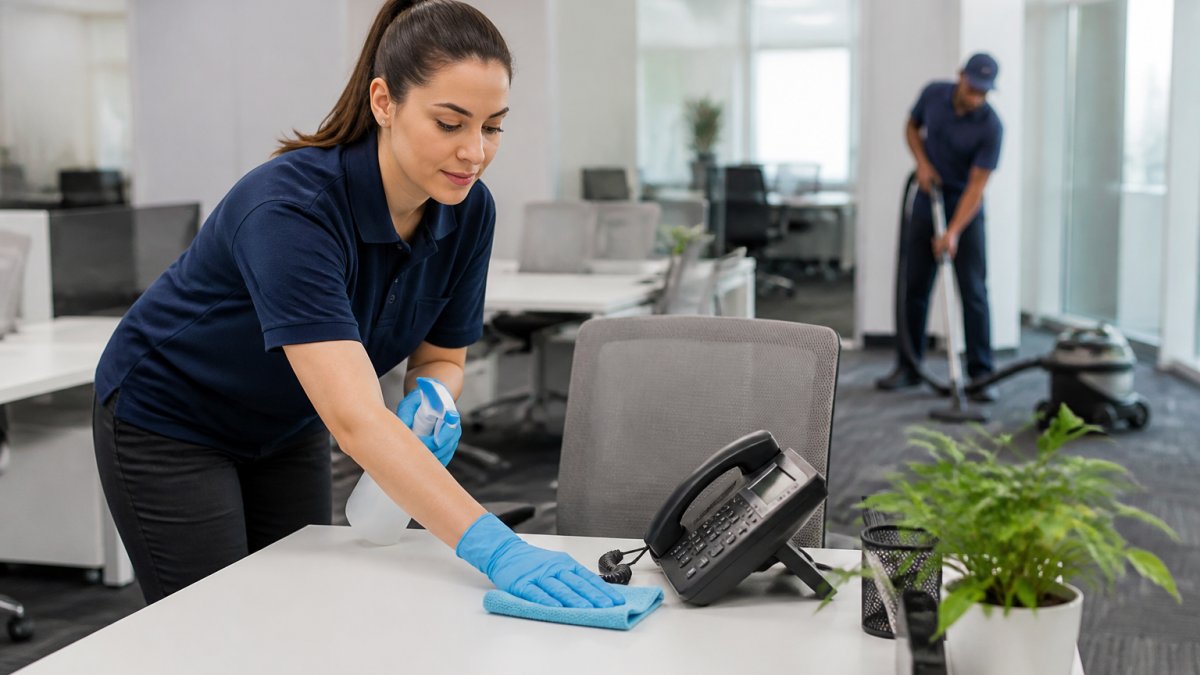
Daily tasks handle hygiene and first impressions. Weekly and periodic tasks protect the building itself.
| Frequency | Typical Tasks | Why It Matters |
|---|---|---|
| Daily | Dusting desks, vacuuming high-traffic areas, washroom cleaning, waste removal | Keeps the workplace presentable and hygienic |
| Weekly | Detail dusting, hard floor mopping, glass and entryway cleaning | Catches buildup daily work misses |
| Periodic | Carpet extraction, floor stripping and waxing, deep washroom descaling | Extends the life of floors and fixtures |
Specialized Needs: Clinics, Retail, and Post-Construction
Clinical spaces need documented sanitation routines that satisfy Manitoba health requirements. Retail shops need front-of-house polish before opening hours. Post-construction cleaning is a different job entirely, removing dust, adhesive residue, and debris so a renovated space is move-in ready. Ask any provider to describe their experience with your specific facility type.
How to Set the Right Office Cleaning Frequency
Office cleaning frequency depends on traffic, facility type, and how the space is used. Most corporate offices settle into daily or three-times-weekly service, while smaller shops often do well with two or three visits a week. Clinics usually need daily attention.
Under-cleaning a high-traffic office costs more in the long run, because floors wear faster and washrooms never quite recover.
Questions that set the right schedule:
- How many people use the space each day?
- Do clients or patients visit?
- Are there food areas or washrooms with heavy use?
- When can cleaners work without disrupting operations?
Evening and after-hours cleaning solves the disruption problem for most businesses. Master Cleaning builds schedules around your operating hours.
Why Bonded Cleaning Staff Matter for Your Business
Bonded cleaning staff are employees who have been vetted and covered by a fidelity bond, which protects your business if a worker steals from the premises. For any office holding sensitive documents or equipment, this is not a nice-to-have. It's the baseline.
What most guides miss is what bonding actually involves. A bond is only as strong as the vetting behind it. Ask providers directly:
- Are staff background-checked before their first shift?
- Are they employees or subcontractors?
- Is the company insured, and can they show a certificate?
- Will the same team clean your space each visit?
That last point matters more than people expect. A consistent team learns your building, notices what's out of place, and stops being a stranger in your office. Master Cleaning assigns the same trained team to each visit, with background-checked, bonded, and insured staff.
What Drives Pricing and How to Compare Quotes
Pricing for office cleaning depends on square footage, frequency, facility type, and the tasks in scope. Providers quote in different ways, so two numbers side by side rarely mean the same thing. Compare the scope, not just the total.
Factors That Change the Quote
- Size and layout: more square footage and more rooms mean more labor; open-plan floors price differently than a warren of small offices
- Frequency: daily service costs more per month than weekly, but less per visit because travel and setup are spread across more visits
- Facility type: clinics and industrial spaces need more specialized work and often more documentation
- Floor types: carpet, tile, and waxed floors each need different care, and periodic floor care is usually a separate line
- Add-ons: post-construction cleanup, window cleaning, and periodic carpet extraction are typically quoted separately
- Access and hours: after-hours or weekend service, security sign-in, and elevator restrictions all add labor time
How Providers Structure a Quote
Most commercial cleaning quotes fall into one of three shapes, and each behaves differently when your needs change:
- Flat monthly contract. A single figure covers the agreed scope at the agreed frequency. Easy to budget, but change orders for extra tasks can be costly unless the rate card is written into the agreement.
- Per-visit pricing. You pay for each scheduled visit. This suits smaller offices with irregular traffic, but the per-visit rate is usually higher than the effective rate inside a monthly contract.
- Task- or area-based pricing. The quote breaks out washrooms, kitchens, open office, and floor care separately. This is the most transparent shape and the easiest to compare across bidders.
Ask which shape a provider is using before you compare totals. A flat monthly figure and a per-visit figure are not the same number wearing different hats.
Reading a Quote Line by Line
A quote should name every task, its frequency, and what's excluded. Watch for vague lines like "general cleaning" that leave room for interpretation. A quote worth signing typically states:
- The room-by-room task list and how often each task happens
- Whether consumables (soap, paper, liners) are included or billed back
- Whether periodic floor care and carpet extraction are inside the monthly figure or quoted separately
- Holiday coverage and what happens on statutory holidays
- The notice period and process for adding or removing tasks
- Whether supervision, inspections, and supplies are bundled or extra
Request a free quote after a walkthrough, and compare the written scopes side by side. If one bid is dramatically lower, the difference is almost always in what's excluded, not in what's included.
Commercial Cleaning Company Questions to Ask Before Signing
Before you sign with any commercial cleaning company, ask about vetting, insurance, staffing consistency, scheduling, and what happens when something goes wrong. The answers separate reliable providers from the rest, but only if you verify them rather than take them on faith.
The Vendor Selection Checklist
Run through this checklist and, where possible, ask for evidence rather than assurances:
- Written, room-by-room scope, request the actual document, not a verbal summary
- Bonding and insurance, ask for a certificate of insurance and confirm the coverage is current
- Background checks, ask whether checks happen before the first shift and whether they are repeated
- Employee or subcontractor status, this affects consistency, supervision, and who is accountable
- Team consistency, ask whether the same crew cleans your space each visit and what happens during vacations
- Missed-visit and complaint process, ask for the response time and who owns the issue
- After-hours capability, confirm the provider can work around your operating hours
- Satisfaction guarantee, ask what it actually covers and how a re-clean is triggered
- References, ask for two or three clients with similar facilities, and call them
How to Verify the Answers
A checklist is only useful if the answers can be checked. A few practical verification steps:
- Insurance: ask for the certificate to be sent directly from the insurer or broker, and confirm the policy is in the company's legal name.
- Bonding: ask what the bond covers and its limit. A fidelity bond protects against theft by covered staff; it is not the same as liability insurance.
- References: ask reference clients how long they have used the provider, whether the same team shows up, and how quickly issues were resolved.
- Site walkthrough: watch how the provider assesses your space. A thorough walkthrough with notes and questions is a better signal than a fast estimate.
Accountability After the Contract Starts
Selection is only half the job. The service agreement should explain how quality is maintained:
- Inspections: ask how often supervisors inspect the site and whether you receive a report.
- Checklists: confirm the crew works from a written task list tied to the scope.
- Issue reporting: ask how you report a missed task and what response time is promised.
- Service reviews: ask whether there is a scheduled review to adjust scope as your needs change.
That last question is worth real weight. References you can actually call are the strongest signal a provider can offer.
The Canadian Centre for Occupational Health and Safety also offers guidance on workplace health and hygiene that's worth reviewing when you set cleaning standards. Master Cleaning backs every plan with regular inspections and a 100% satisfaction guarantee, so standards hold up over time.
Frequently Asked Questions
What is included in office cleaning services?
A typical scope covers dusting desks, furniture, and equipment, vacuuming carpets, floor cleaning and care, washroom sanitizing, and emptying waste and recycling. Many contracts add kitchen and breakroom cleaning, glass and entryway touchpoints, and periodic deep work like carpet extraction. Ask for the task list in writing with frequencies attached, so daily, weekly, and monthly items are clearly separated. Clinics and post-construction sites need additional scope, so confirm those tasks are named in the agreement rather than assumed.
How often should an office be professionally cleaned?
Office cleaning frequency depends on headcount, foot traffic, and how many visitors you receive. A small professional office may manage with two or three visits a week, while a busy workplace with shared kitchens and washrooms usually needs daily service. Clinics and retail with heavy customer traffic often require daily cleaning plus periodic deep cleaning. Set the frequency against your actual usage, then adjust after a month or two of inspections rather than guessing at signing.
Why should cleaning staff be bonded and insured?
Bonding protects your business if a cleaner is suspected of theft, and insurance covers damage to your premises or equipment. Together they mean a mishap is handled through the provider rather than out of your own pocket. Ask for a certificate of insurance and confirmation of bonding before the first visit, and check that background checks are part of hiring. A provider that answers these questions quickly and in writing is usually the one that also shows up on schedule.
What should I ask before hiring a commercial cleaning company?
Ask who will actually clean your space and whether the same team returns each visit. Confirm how missed days are handled, what the satisfaction guarantee covers in practice, and how inspections are scheduled. Request a written scope with frequencies, a certificate of insurance, and a sample quote that separates recurring tasks from periodic extras. Finally, ask how they handle after-hours access, keys, and alarm codes, since that is where most scheduling problems start.
Finding a cleaning provider you can trust with your keys, your documents, and your reputation takes more than a quick phone call. Master Cleaning handles that risk for you with bonded and insured staff, background-checked employees, customized cleaning plans, the same trained team on every visit, and green-certified products wherever possible. Get started with Master Cleaning and give your team a workspace that's ready before they arrive.