Quick Summary
Medical office disinfection frequency describes how often each area of a clinic is disinfected, and guidelines set a baseline for each room type. Exam rooms need the most attention, with touch points disinfected after every patient, while waiting rooms and restrooms are typically disinfected twice daily during operating hours.
- Exam room touch points should be disinfected after every patient.
- Waiting room and restroom touch points are disinfected twice daily during operating hours.
- Visibly soiled surfaces or body fluids require immediate cleaning, overriding the schedule.
- Disinfectants must stay wet for the labeled contact time to be effective.
- Document cleaning dates, staff names, products used and contact time for audits.
Table of Contents
- What Medical Office Disinfection Frequency Guidelines Cover
- Baseline Cleaning and Disinfection Frequency by Room Type
- Medical Office Cleaning Schedule: Daily, Between-Patient and End-of-Day Tasks
- Exam Room Cleaning Between Patients and Procedure-Based Adjustments
- Waiting Room Cleaning Frequency During Operating Hours
- Clinic Cleaning Checklist, Contact Time and Documentation
- Building Your Disinfection Schedule with Master Cleaning
- Frequently Asked Questions
What Medical Office Disinfection Frequency Guidelines Cover
Last Updated: November 28, 2026
Medical office disinfection frequency guidelines tell you how often each part of a clinic should be cleaned and disinfected. They also say when cleaning must happen right away, such as after a patient leaves or when a surface is visibly soiled. Clinic cleaning plans are often built around these ideas, so practice managers can see what gets done and when.
Disinfection frequency is the number of times a surface or room gets disinfected in a set period. A dental office might wipe an exam chair after every patient, while a front desk counter might need attention only twice a day. The right frequency depends on how many people touch the surface and how much risk it carries.
Most guidance starts from a few shared principles:
- Routine cleaning removes dirt and debris from every area on a regular schedule.
- Disinfection kills germs on high-risk surfaces, usually after cleaning.
- Between-patient cleaning resets exam rooms and equipment before the next person arrives.
- Visibly soiled surfaces get cleaned right away, regardless of the schedule.
A common mistake is treating every room the same. An exam room, a waiting room and a restroom carry very different levels of contamination risk. Guidelines exist so you can match effort to that risk instead of guessing.
Public health bodies in Canada publish infection prevention and control guidance that many clinics use as a starting point, including materials from the Public Health Agency of Canada's infection prevention and control guidelines. These documents explain the principles, but every clinic still has to turn them into a schedule that fits its own patients and staff.
Baseline Cleaning and Disinfection Frequency by Room Type
The baseline schedule sets a minimum for each room. Start here, then adjust for your patient volume, procedures, and patient population. The table below turns general guidance into a working reference you can post or adapt. It separates routine cleaning (removing soil) from disinfection of touch points (killing germs) and names the trigger that forces extra work outside the schedule.
| Area | Routine Cleaning | Disinfection of Touch Points | Trigger for Extra Cleaning |
|---|---|---|---|
| Exam rooms | Daily and between patients | Every patient (table, chair, counter, door handle) | Visible soiling, body fluid, or aerosol-generating procedure |
| Waiting room | At least daily | Twice daily during operating hours (chairs, armrests, check-in screen) | Spills, heavy traffic, or symptomatic patients |
| Reception counter | Daily | Several times per day (counter, pens, card terminal) | Shared pens or paperwork handling |
| Restrooms | At least daily | Twice daily (faucets, flush handles, door handles) | Visible contamination or clog |
| Patient-care equipment | After each use | After each patient (blood pressure cuffs, stethoscopes, otoscopes) | Before storage or transfer between rooms |
| Office and staff areas | Daily | Daily (shared keyboards, phones, breakroom surfaces) | Food spills or shared devices |
Exam rooms need the most attention because the same surfaces touch many patients. High-touch and frequently touched surfaces include door handles, light switches, chair arms, faucets, and counter edges. Wipe these with a disinfectant approved for use in Canada, and follow the label instructions exactly, including the contact time discussed later.
Restrooms deserve a special note. They are easy to forget, yet they hold many shared surfaces. Set a fixed time each day for restroom disinfection so it never slips, and add a mid-day round if patient volume is high.
Disinfectants need enough wet contact time to work, so a surface that dries too fast has not been disinfected. The frequencies in any schedule assume staff actually achieve contact time; if they do not, the schedule will not deliver the intended result.
How to adjust the baseline for patient and procedure risk
The table is a floor, not a ceiling. Most practitioners find the baseline needs to move in response to five factors:
- Patient volume: A clinic seeing 40 patients a day needs more frequent waiting-room and restroom rounds than one seeing 12.
- Infectious symptoms: When patients present with respiratory or gastrointestinal symptoms, increase disinfection of shared surfaces and consider separate waiting arrangements.
- Aerosol-generating procedures: Procedures that create splatter or aerosols require full room disinfection, including floors and walls near the work area, before the next patient.
- Visible contamination: Any visible soiling or body fluid overrides the schedule and requires immediate cleaning and disinfection.
- Vulnerable populations: Clinics serving immunocompromised patients, infants, or the elderly should lean toward the more frequent end of every range.
Document the adjustments you make so the schedule reflects your actual clinic, not a generic template. That record also becomes your defense during an audit or inspection.
Medical Office Cleaning Schedule: Daily, Between-Patient and End-of-Day Tasks
A good schedule breaks work into three timing groups: tasks between patients, tasks during the day and tasks at closing. Keeping them separate makes it easier to assign responsibility and check that nothing is missed.
Between-patient tasks are the fastest and most frequent:
- Wipe the exam table, chair and counter with an approved disinfectant.
- Replace disposable barriers and paper covers.
- Clean reusable instruments and place them in the correct holding area.
- Empty the sharps and waste containers when they are full.
Daily tasks cover the whole clinic:
- Mop floors and clean restrooms.
- Disinfect the waiting room chairs, armrests and check-in screens.
- Dust horizontal surfaces and clean glass doors.
End-of-day tasks prepare the clinic for the next morning:
- Run a full disinfection of exam rooms that were used.
- Restock supplies and document what was cleaned.
- Check that disinfectant containers are sealed and labelled.
Keep the schedule visible in each room so staff can check off each task. Many clinics find that a simple checklist posted on the wall works better than a long manual.
Exam Room Cleaning Between Patients and Procedure-Based Adjustments
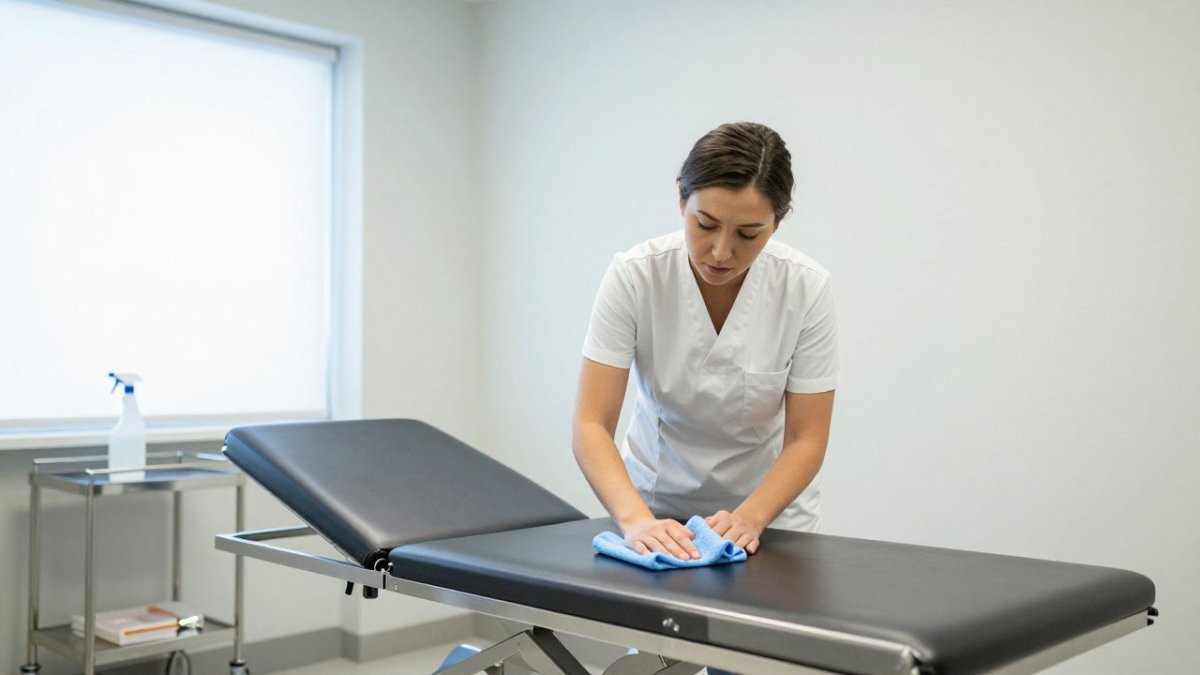
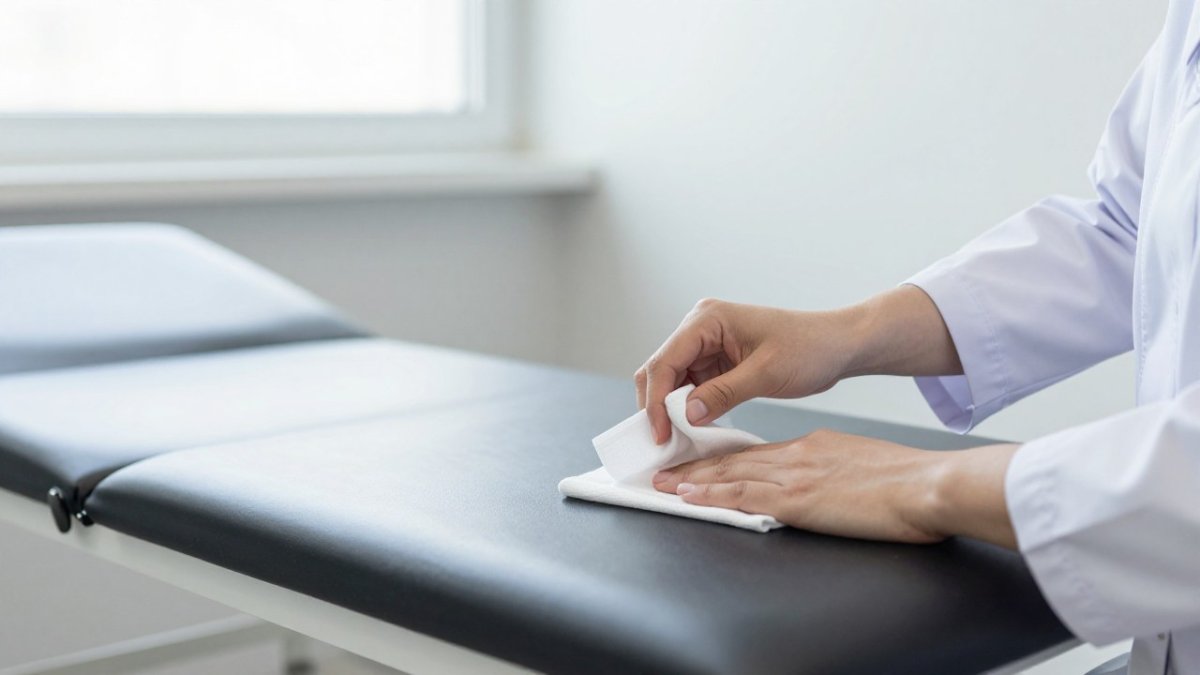
Exam rooms are where most cross-contamination risk lives, so they need the most careful routine. A clinician wiping down an exam table with a disinfectant wipe is a good visual of the process. Wipe from the cleanest area to the dirtiest, and never reuse a cloth on a second surface without re-wetting it.
Procedure type changes the schedule. A room used for minor checkups needs less work than one used for minor surgical procedures or injections. When a procedure creates splatter or blood, clean and disinfect the whole room before the next patient, not just the table.
Consider these adjustments:
- Routine visits: Disinfect the exam table and touch points between each patient.
- Procedures with fluids or splatter: Clean the floor, walls near the work area and all equipment.
- Shared equipment: Disinfect any device that moves between rooms before it enters the next one.
Clinics that see many patients in a day often find the room turnover goes faster when staff keep disinfectant and clean cloths stocked at each exam room door.
Waiting Room Cleaning Frequency During Operating Hours
The waiting room is busy, shared and often overlooked. Patients sit, touch surfaces and wait together, so the room needs regular attention while the clinic is open.
Plan a light cleaning round several times a day. Focus on the places people touch most:
- Chair arms and armrests
- Check-in counter and sign-in pens
- Door handles and the washroom door
- Magazine or tablet surfaces
- Water dispensers and coat hooks
Spills and visible dirt should be cleaned as soon as they are seen. A spill left alone becomes a hazard and a complaint.
Staff who work the front desk can often handle these short rounds. Put the task on a timed reminder so it happens during busy periods too.
Clinic Cleaning Checklist, Contact Time and Documentation
A checklist keeps the whole team on the same page, but only if it captures enough detail to be auditable. Include the room, the task, the product used, the contact time achieved, and the time the work was done. Initial each line so you know who did the work, and have a second person spot-check high-risk rooms at least weekly.
Pay close attention to contact time. Every disinfectant label states how long the surface must stay wet for the product to kill germs. Many staff wipe and move on too quickly. Follow the label, not the habit. If a product requires a one-minute wet time, a five-second wipe does not count, and the checklist should record that the surface was kept wet for the labeled time, not just that it was wiped.
Watch out: Mixing disinfectants or using a product past its dilution date can make contact time meaningless. Store products sealed, label secondary containers, and discard diluted solutions according to the manufacturer's instructions.
Who owns which task
Clarity about ownership prevents the two most common failures: tasks that everyone assumes someone else did, and handoffs where the next shift does not know what was finished. A common pattern is to split responsibilities:
- Clinical staff: between-patient disinfection of exam tables, chairs, and shared equipment; immediate cleanup of visible soiling.
- Environmental-services or dedicated cleaning staff: daily and end-of-day cleaning of floors, restrooms, waiting areas, and reception.
- Front-desk staff: timed waiting-room touch-point rounds during operating hours.
Build a short handoff note at shift change that lists rooms cleaned, any incidents, and supplies that need restocking. Sign-off at the end of each shift closes the loop.
Documentation and audit metrics
Documentation also helps during audits and inspections. Record:
- Date and time of each cleaning round
- Name of the staff member
- Product used and its dilution, if required
- Contact time achieved for disinfected surfaces
- Any incident, such as a spill or body fluid exposure
Review these records each month. Patterns often show where a room needs more frequent attention. Measurable audit results, such as completion rate (tasks done versus scheduled), number of missed tasks per week, and observed compliance during spot checks, help you decide where to improve. A simple monthly summary of those three numbers is enough to spot drift before it becomes a compliance problem.
Clinics that want a deeper walkthrough of approved disinfectants and reusable equipment protocols can read the Canadian guidance on hospital-grade disinfectants and contact times for reference.
Building Your Disinfection Schedule with Master Cleaning
Turning these guidelines into a working schedule takes planning. Start by listing every room, its patient volume and the procedures done there. Then set the baseline frequencies from the table above and adjust for risk.
Master Cleaning builds customized cleaning plans based on individual facility needs. Our staff are bonded and insured, background-checked, and assigned to the same trained team for each visit.
We use green-certified products wherever possible, and our 100% satisfaction guarantee applies to our service.
Ready to build a schedule that fits your clinic? Request a quote from Master Cleaning to start planning your disinfection routine. Our team can review your current setup and suggest the frequency that makes sense for your patients.
Get a cleaning plan built for your clinic with Master Cleaning.
Frequently Asked Questions
How often should exam rooms be disinfected in a medical office?
Exam rooms should be disinfected between every patient, and cleaned daily at minimum. Frequently touched surfaces such as exam tables, counters, sinks and door handles need disinfection after each visit, while floors and walls typically follow a daily routine. Rooms used for procedures or patients with known infections may need more frequent or terminal cleaning. Written schedules should match the actual patient flow and the disinfectant's label directions, including contact time. For a tailored plan, Master Cleaning can review your clinic and provide a quote through its website.
Do medical offices need a written cleaning and disinfection schedule?
A written schedule is strongly recommended because it defines who cleans what, how often, and with which products. It supports a consistent medical office cleaning schedule, provides a checklist for staff and contractors, and creates records that show routine tasks were completed. The schedule should list room types, high-touch surfaces, between-patient tasks, end-of-day tasks and restroom cleaning. Reviewing it periodically and after any change in services or patient volume keeps it current.
How often should waiting rooms and restrooms be cleaned and disinfected?
Waiting rooms should have high-touch surfaces such as chairs, armrests, reception counters, door handles and shared pens disinfected at least daily and more often during busy operating hours. Restrooms should be cleaned and disinfected at least daily, with toilets, sinks, faucets, soap dispensers and door handles checked and wiped as needed throughout the day. Visibly soiled areas should be cleaned as soon as they are noticed, regardless of the scheduled frequency.
What is the difference between cleaning and disinfecting in a clinic?
Cleaning removes dirt, dust and organic matter from surfaces, while disinfecting uses an approved product to reduce or kill microorganisms. Cleaning should come first, because disinfectants work poorly on soiled surfaces. Disinfectants must be used according to the product label, including the correct dilution and contact time that the surface stays wet. Products should be approved for use in Canada, and staff should check the product's label and safety data sheet before use.
