Table of Contents
- What Janitorial Services for Small Retail Shops Actually Cover
- A Retail Store Cleaning Checklist You Can Adapt
- Retail Floor Cleaning Services: Matching the Method to the Surface
- After-Hours Retail Cleaning: Working Around Store Hours and Foot Traffic
- Commercial Cleaning Cost for Small Businesses: What Drives the Quote
- High-Touch Surfaces and Protecting Your Inventory
- How to Vet a Janitorial Provider Before You Sign
- Frequently Asked Questions
Last Updated: October 16, 2026
What Janitorial Services for Small Retail Shops Actually Cover
Janitorial services for small retail shops cover the cleaning and upkeep tasks that keep a store presentable, safe, and ready for customers, from the sales floor and fitting rooms to the back stockroom and staff washroom.
That changes the job. A mall can absorb a messy corner. A 1,200-square-foot boutique cannot.
The work splits into two zones, and the split matters more than most owners expect.
Customer-Facing Areas vs. Back-of-House
Customer-facing areas are the spaces a shopper judges in the first ten seconds: entryway and mats, sales floor, display counters, mirrors, fitting rooms, checkout, and the front windows.
Back-of-house covers the stockroom, staff break room, washroom, and receiving area.
Most small retailers we talk to have never had this distinction explained. They hire on price, then wonder why the front looks fine while the stockroom becomes a dumping ground.
A Retail Store Cleaning Checklist You Can Adapt
A retail store cleaning checklist is a written list of daily, weekly, and monthly tasks assigned to specific areas of the shop. It turns "keep the store clean" into something a crew can follow and a manager can verify.
Daily, Weekly, and Monthly Tasks
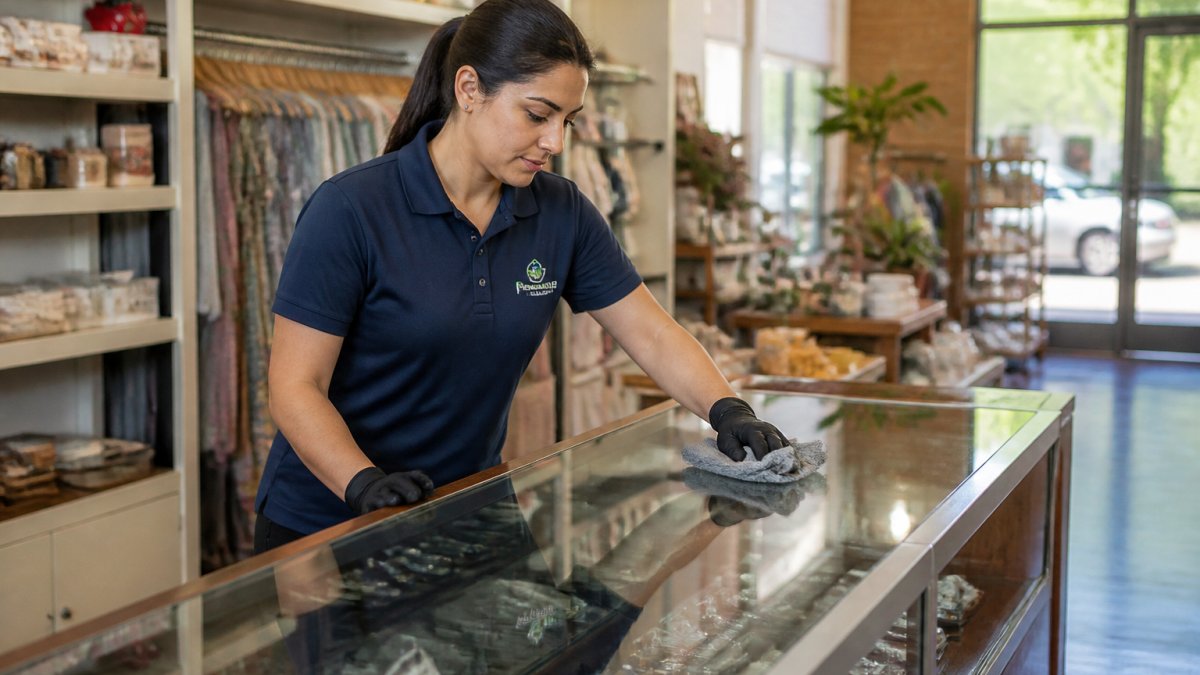
- Daily: Sweep and mop entryway, vacuum or spot-clean sales floor, wipe display counters and mirrors, clean and restock washrooms, empty waste and recycling, sanitize checkout and card terminal
- Daily: Wipe high-touch surfaces: door handles, handrails, fitting room hooks, and POS screens
- Weekly: Dust shelving and top stock, clean interior glass and front windows, mop stockroom and break room, wipe light switches and shared equipment
The most common mistake is a checklist that lists tasks but never assigns them to a day. If "clean fitting rooms" has no frequency, it becomes nobody's job.
Retail Floor Cleaning Services: Matching the Method to the Surface
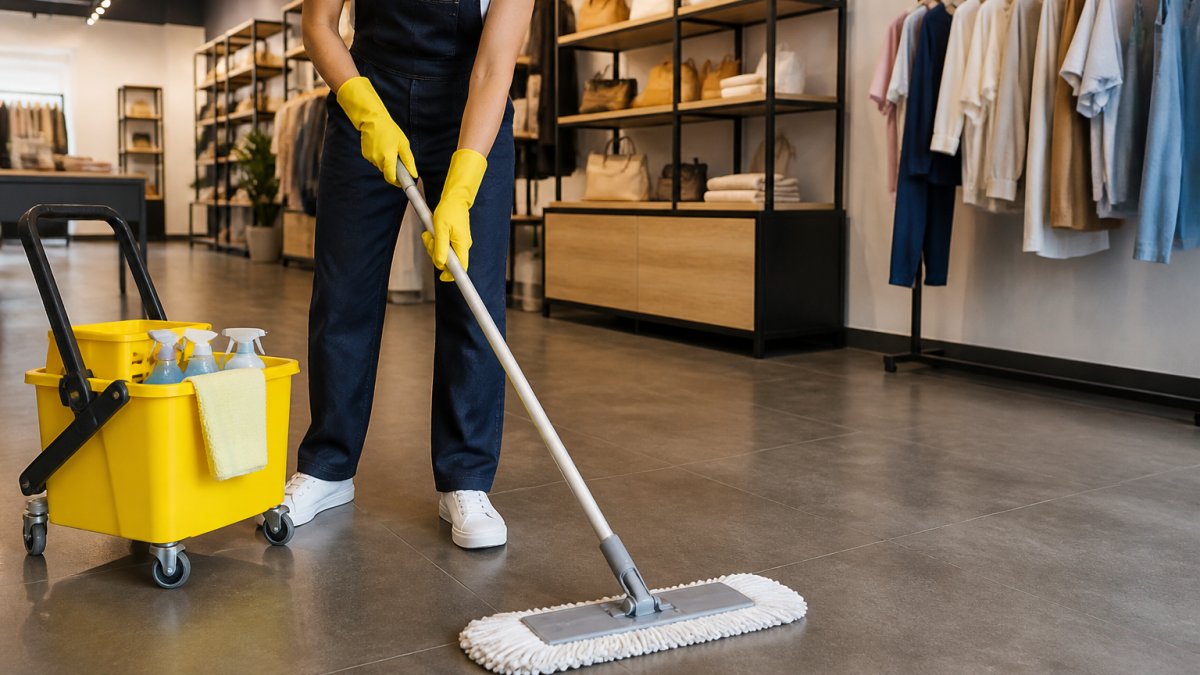
Retail floor cleaning services should match the cleaning method to the material, because the wrong product or pad can permanently dull a floor. Most small shops have at least two floor types under one roof, each needing a different approach:
| Floor Type | Routine Method | Periodic Method | Watch Out For |
|---|---|---|---|
| Vinyl or LVT | Dust mop, damp mop | Machine scrub, low-speed burnish | Excess water at seams |
| Sealed concrete | Dust mop, neutral cleaner | Auto-scrub, reseal as needed | Acidic cleaners dull the sealer |
| Carpet and rugs | Daily vacuum, spot treat | Hot-water extraction | Over-wetting causes odor |
| Tile and grout | Sweep, damp mop | Grout brush, deep clean | Harsh bleach damages grout |
| Wood or laminate | Dry mop only | Damp mop, approved product | Standing water warps boards |
Entry mats do more work than most owners realize. A good mat system captures grit before it reaches the sales floor, cutting how often you need to scrub. If your floors look dull a week after cleaning, check your mats before blaming the crew.
After-Hours Retail Cleaning: Working Around Store Hours and Foot Traffic
After-hours retail cleaning is the practice of scheduling janitorial work outside trading hours so crews can clean without disrupting shoppers or blocking aisles.
The practical problems are real. A crew arriving at 6:15 PM while you cash out gets in the way.
What to include in the schedule:
- Exact arrival and finish windows
- Which areas must be dry before opening
- Lock-up and alarm procedures for the crew
Some shops with steady daytime traffic prefer split scheduling: light touch-ups during slow hours, deep work after close.
Commercial Cleaning Cost for Small Businesses: What Drives the Quote
Commercial cleaning cost for small businesses depends on square footage, frequency, surface types, and how much work is specialized, not on a single flat rate. Anyone who quotes a number before walking the space is guessing.
The main cost drivers:
- Size and layout. More square footage and tighter aisles mean more labor time. A 1,200-square-foot boutique with a narrow stockroom corridor takes longer per square foot than an open 2,000-square-foot showroom.
- Frequency. Daily service costs more per month than three visits a week, but the per-visit rate often drops as travel and setup spread across more visits.
- Surface mix. Carpet extraction, hard-floor scrubbing, and interior glass each add time and equipment. A store with 60% carpet and 40% LVT needs two routines on the same visit.
How to Compare Quotes Without Getting Fooled
A common pattern among small retailers is to collect three quotes, pick the lowest, and discover two months later that fitting room deep cleans and floor scrubbing were never included. The fix is to normalize every quote against the same scope document.
Build a one-page scope sheet with these columns, then ask each provider to fill it in:
| Line item | Frequency | Included? | Notes |
|---|---|---|---|
| Sales floor vacuum or dust mop | Daily | ||
| Entryway and mat service | Daily | ||
| Washroom clean and restock | Daily | ||
| Checkout and POS wipe-down | Daily | ||
| Interior glass and mirrors | Weekly | ||
| Fitting room deep clean | Monthly | ||
| Hard floor machine scrub | Monthly or quarterly | ||
| Carpet hot-water extraction | Quarterly or seasonal | ||
| Stockroom and break room | Weekly |
When every provider prices the same sheet, the bottom-line numbers become comparable. The cheapest quote is often missing two or three rows, which explains the gap.
What a Written Quote Should Contain
Ask for a quote that states, in plain language:
- The exact tasks and their frequency
- Which areas are in scope and which are excluded
- Whether supplies and equipment are included or billed separately
A quote that says "general cleaning" without a task list is an estimate waiting to become a dispute.
High-Touch Surfaces and Protecting Your Inventory
High-touch surfaces are the shared points many hands contact in a day, and they deserve more frequent cleaning than the rest of the store. In a small shop that means door handles, card terminals, fitting room hooks and benches, handrails, shared baskets or carts, and any product customers pick up and put back. Treat high-touch points as a separate pass, not part of the general wipe-down: a mid-day touch-up on the busiest points and a full clean after close, so the surfaces customers handle do not carry the day's traffic into the evening.
A Surface-by-Surface Routine for Small Shops
| Surface | Frequency | Method | Watch Out For |
|---|---|---|---|
| Entry door handles and push plates | Mid-day and after close | Wipe with a compatible disinfectant | Residue buildup on brushed metal |
| Card terminals and POS screens | After close, plus mid-day in peak season | Wipe with a screen-safe product | Liquid seeping into keypads |
| Fitting room hooks, benches, and mirrors | After close | Wipe, then clean glass separately | Product transfer from garments |
| Baskets and carts | After close | Wipe handles and rims | Worn coatings that trap grime |
| Handrails and display case edges | Mid-day | Wipe with a mild product | Streaking on dark finishes |
| Shared counters and wrap stations | After close | Wipe, then sanitize | Paper and packaging absorbing moisture |
Retail hygiene is not just about appearance. It affects how customers feel about handling your merchandise, and your staff, who touch the same surfaces all day.
Protecting Inventory From Cleaning Products
Inventory protection is the other half of this. Careless cleaning products and methods damage stock in one of three ways: moisture wicking into paper or cardboard, residue transferring from a surface to merchandise, or a harsh chemical dulling or discoloring a finish.
- Keep liquids away from cardboard packaging, which wicks moisture and stains
- Use the mildest product that does the job on display surfaces and shelving
- Avoid spraying cleaners directly onto merchandise or near open stock; spray the cloth, not the shelf
Ventilation matters too. In a small, closed shop, strong-smelling products can linger into opening hours and affect how the store smells to the first customers. If a product needs ventilation, schedule that task early in the after-hours window, not last.
Sensitive Merchandise and Food Areas
If your shop sells food, beverages, or cosmetics, the cleaning routine needs a separate set of products for those zones. A crew that knows which surfaces touch food or skin, and which products are approved for those areas, avoids cross-contamination between the washroom, the sales floor, and the counter. A crew that understands your inventory is worth more than one that simply cleans fast: the same people learn which shelves are fragile, which displays scratch, and which products cannot go near moisture.
How to Vet a Janitorial Provider Before You Sign
Vetting a janitorial provider comes down to five checks: insurance, staff screening, references, a written scope, and a clear answer to what happens when something goes wrong.
Ask these questions before you sign anything:
- Are you bonded and insured? Ask for proof, not a verbal yes.
- How are your staff screened? Background-checked employees protect your stockroom and your documents.
- Will we get the same crew each visit? A consistent team learns your store and your standards.
- What is the written scope? Get every task, frequency, and area in writing.
- What is your satisfaction policy? Know the process for fixing a missed task before you need it.
We built Master Cleaning around these exact points: bonded and insured staff, background-checked employees, a customized cleaning plan for each facility, and the same trained team assigned to every visit.
If you run a small shop, you do not need a sprawling contract.
Frequently Asked Questions
What cleaning tasks should be included in janitorial services for a small retail shop?
A standard scope covers floors (sweeping, vacuuming, mopping), dusting of shelving and displays, restroom sanitizing, break room cleaning, waste and recycling removal, and wiping high-touch surfaces like door handles, POS terminals, and fitting room rails. Customer-facing areas usually get daily attention, while tasks like deep carpet extraction or stripping and waxing floors run on a monthly or quarterly schedule. Ask for the scope in writing so you can compare quotes on equal terms.
How often should a small retail store be professionally cleaned?
Most small shops with regular foot traffic need daily or five-day-per-week service for floors, restrooms, and high-touch surfaces. Lower-traffic stores can often manage on three visits per week. Deep cleaning tasks, such as carpet extraction, grout scrubbing, and floor finish work, typically run monthly to quarterly depending on how many customers walk through. Your service frequency should follow your traffic patterns, not a one-size-fits-all schedule.
How much do janitorial services for a small retail shop cost?
Commercial cleaning cost for small businesses depends on square footage, service frequency, floor types, and how many restrooms are in scope. A 1,000 square foot shop cleaned three times a week prices differently from a 3,000 square foot store cleaned daily. Because rates vary by building and schedule, ask each provider for a free estimate based on a walkthrough rather than accepting a phone quote. Master Cleaning can provide a written quote after reviewing your space.
What should I look for when hiring a retail cleaning company?
Check four things: bonding and insurance, a background-checked and consistently assigned crew, a written scope of work, and a clear process for missed visits or complaints. Ask whether the same team will service your store each visit, since rotating staff is a common source of inconsistent quality. Also confirm the provider carries liability coverage and can work after hours without disrupting your opening routine. A 100% satisfaction guarantee is only meaningful if you know the exact steps for raising an issue.
Small retail shops face a simple problem: the store has to look its best every single day, but you cannot afford to manage cleaning on top of everything else. Master Cleaning handles it with customized cleaning plans, background-checked and bonded staff, flexible scheduling around your hours, and green-certified products, all backed by a 100% satisfaction guarantee. Contact Master Cleaning to get a free estimate and a plan built for your store.